
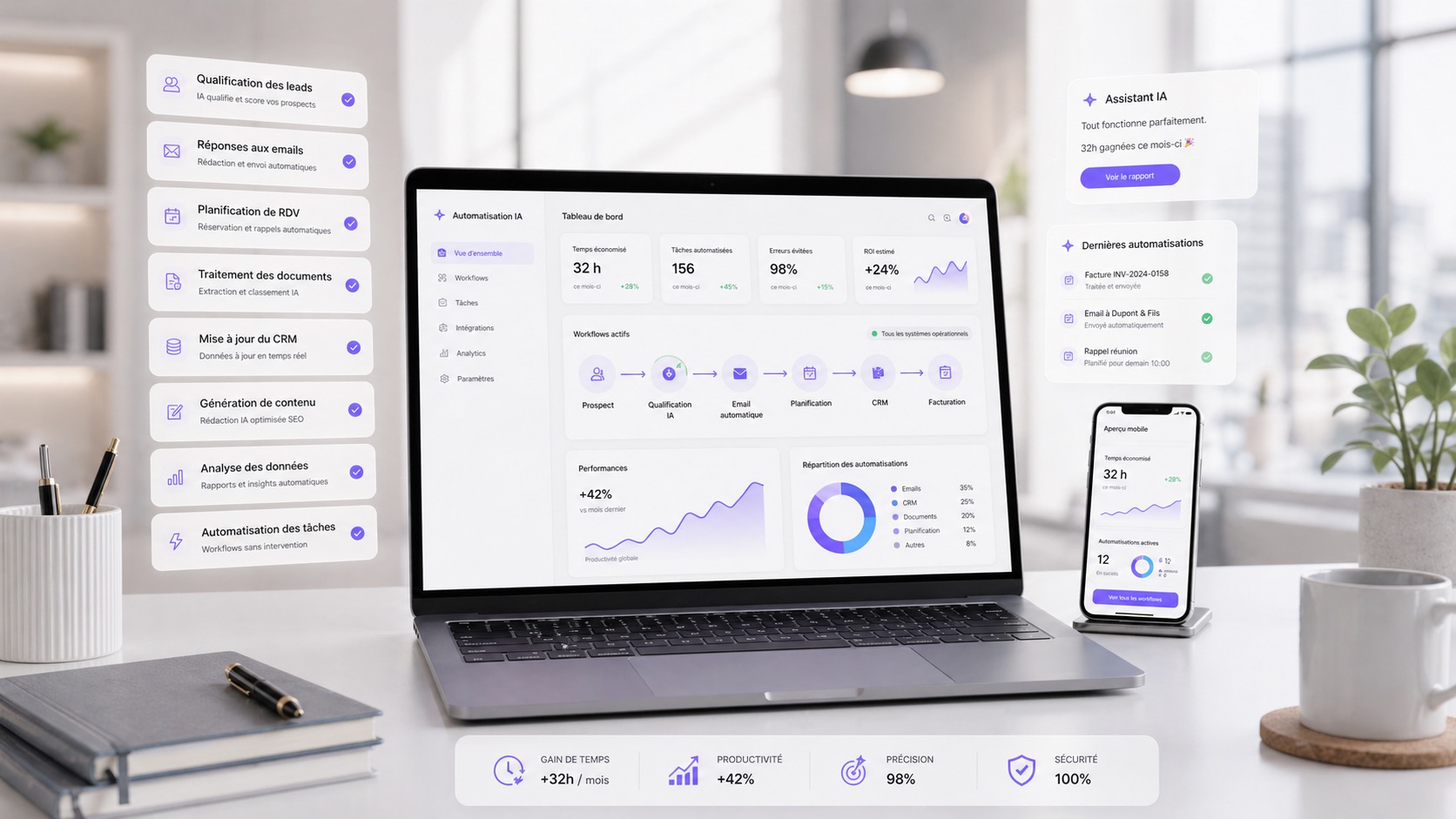
Artificial intelligence is no longer reserved for large companies.
Today, an SME, craftsperson, independent professional or agency can already use AI to save time, reduce repetitive tasks and better organize its activity.
In France, 26% of micro-businesses and SMEs reported using at least one AI solution in 2025, twice as many as in 2024. The most common uses include content generation, assistants, chatbots, task automation and document or data analysis.
In short: AI is becoming a practical tool for working faster and more efficiently.
AI does not replace the company, it helps it
When people talk about artificial intelligence, many imagine a complicated tool reserved for experts.
In reality, AI can simply automate everyday tasks.
These are often small tasks, but together they take a lot of time.
AI helps automate part of that workload.
- Answering customer requests
- Sorting information
- Creating documents
- Analyzing data
- Preparing emails
- Summarizing files
- Qualifying prospects
- Organizing sales follow-up
Automating customer requests
A company often receives the same questions:
With AI, it is possible to set up an assistant or smart form that answers first questions, collects the right information and guides the customer towards the right action.
For example, instead of receiving a vague message like Hello, I want a website, you can receive an already structured request:
- What are your prices?
- What services do you offer?
- What are your timelines?
- How can I book an appointment?
- How can I request a quote?
- project type
- estimated budget
- website goal
- desired deadline
- prospect contact details
- specific needs
The result: you save time and handle more qualified requests.
Automating administrative tasks
Administration is one of the biggest bottlenecks for many companies.
AI can help prepare documents, classify files, summarize conversations, generate meeting notes or organize important information.
It can also connect to your existing tools: contact forms, Google Sheets, CRM, emails, invoicing tools, Notion, Airtable or other business software.
The goal is not to replace everything.
The goal is to reduce repetitive tasks so you can focus on what truly matters: your customers, your services and your growth.
Automating content creation
AI can also help produce content faster.
For example:
- article ideas
- LinkedIn posts
- service descriptions
- sales emails
- customer replies
- website pages
- FAQs
- video scripts
- newsletters
Of course, automatically generated content should not be published without review.
But AI can save a huge amount of time on the first draft. It helps structure ideas, rewrite, simplify and publish more regularly.
For a company that wants to be visible online, that is a real advantage.
Automating sales follow-up
Many companies lose prospects simply because they do not follow up at the right time.
A customer asks for a quote. Then they do not reply. And the company forgets to follow up.
With AI automation, it is possible to create a cleaner follow-up process.
For example, after a quote request, the system can send a confirmation email, create a prospect record, notify the team, schedule a follow-up and summarize the customer's needs.
AI can also help classify prospects according to their level of interest.
A very clear prospect with a budget and precise timeline can be prioritized. A vague request can be set aside or receive an automatic email to collect more information.
Automating document and data analysis
AI can also help understand documents or data faster.
It can summarize a long file, extract key points, compare several documents or find precise information.
For a company, this can help analyze:
- quotes
- contracts
- customer feedback
- data tables
- emails
- meeting notes
- reports
- forms
France Num also notes that 75% of micro-businesses and SMEs already use their data to manage their activity, especially accounting, financial and commercial data.
With AI, that data can become easier to understand and use.
AI must be properly integrated
The most important thing is not simply using AI.
The most important thing is integrating it intelligently into the company.
McKinsey explains that companies getting the most value from AI do not simply test tools: they rethink their processes and integrate AI directly into their ways of working.
In other words, AI must serve a precise objective.
- Save time
- Reduce errors
- Improve customer follow-up
- Handle requests better
- Automate a repetitive task
- Help make better decisions
Without a clear goal, AI becomes just a gadget.
With the right system, it becomes a real efficiency lever.
Humans remain essential
AI can automate many things, but it should not decide everything alone.
It can suggest, sort, summarize, generate or prepare. But humans must remain in control, especially for important decisions, sensitive replies or confidential data.
Good AI automation does not replace your expertise.
It helps you work faster, with fewer unnecessary tasks.
Conclusion
AI can automate many business tasks: customer requests, emails, documents, content, sales follow-up, data analysis or internal organization.
But its real value is not looking modern.
Its real value is helping you save time, improve organization and make your activity more efficient.
A well-designed automation can turn a task that used to take several hours per week into a simple, fast and reliable process.
For a company, AI is therefore not just a technology.
It is a concrete tool to work better, answer customers more effectively and focus on what truly creates value.